
When a child struggles in the classroom or at home, we often jump straight to behavior.
But what looks like defiance, inattention, or emotional outbursts is frequently a sensory regulation need underneath.
Understanding the difference between behavior and sensory processing changes everything:
-
How we respond
-
What strategies actually help
-
Whether a child feels supported or misunderstood
This is why we created a Behavior vs. Sensory graphic — to help educators and families pause, reframe, search for a trigger, and respond with intention instead of assumption.
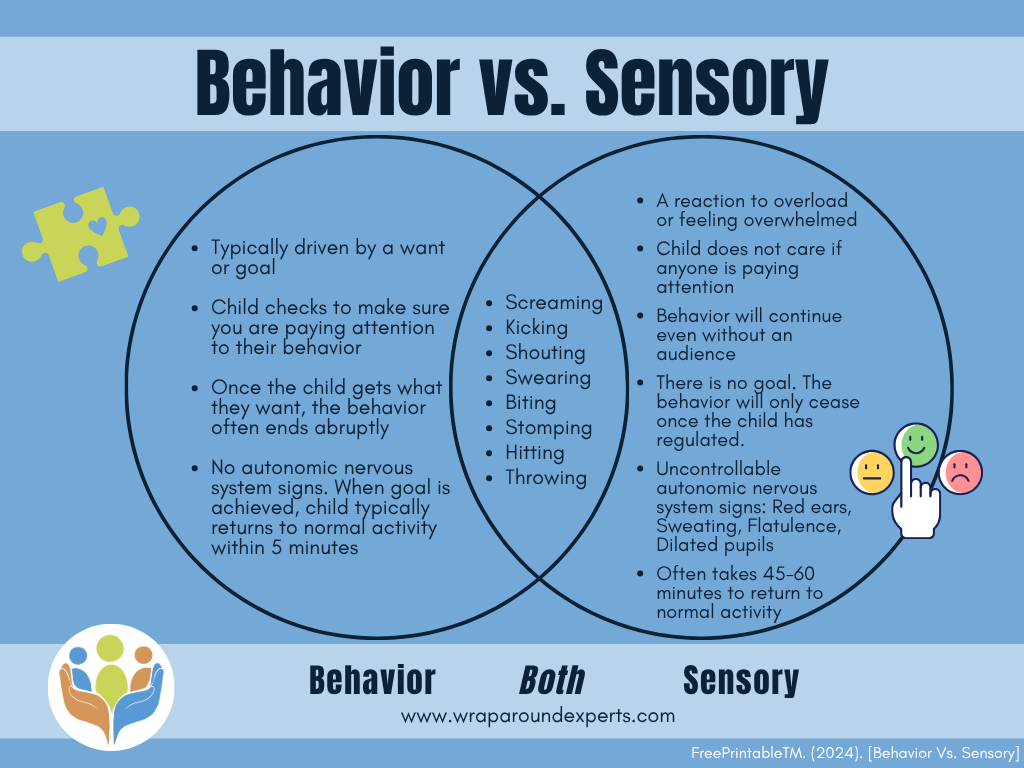
Below, we break down practical, evidence-based sensory strategies that support regulation, attention, and participation across school and home environments.
1. Proprioceptive System (Body Awareness & Force)
Most regulating sensory input — strongly supports attention, emotional regulation, and postural control.
For Deep-Pressure Seekers
(crashing, pushing, fidgeting, rough play)
Goal: Provide intentional heavy work so the body doesn’t seek it during instruction.
✔ Chair or wall push-ups
✔ Carrying books, bins, or attendance folders
✔ Theraband on chair legs for foot resistance
✔ Weighted lap pad or vest (OT guided)
✔ Compression shirts or pressure vests
✔ Animal walks (bear, crab) during transitions
✔ Working in prone (on elbows) or over a therapy cushion
✔ Recess not withheld (critical regulation input)
Why it works: Proprioceptive input has a calming, organizing effect on the nervous system and improves body awareness and impulse control.
For Deep-Pressure Avoiders
(discomfort with touch, pressure, movement)
Goal: Offer predictable, choice-based input without surprise or force.
✔ Allow opt-out of deep pressure tools
✔ Offer lighter resistance options (wall lean vs. push-ups)
✔ Gradual exposure to heavy work with student control
✔ Clear warnings before physical contact or transitions
✔ Respect boundaries around weighted items
Why it works: Avoiders experience sensory input as threatening; predictability restores nervous system safety.
2. Vestibular System (Movement & Balance)
A powerful system — can be organizing or dysregulating depending on the child.
For Movement Seekers
(rocking, tipping, constant motion)
Goal: Provide movement before seated work.
✔ Built-in movement breaks (every 20–40 minutes)
✔ Alternative seating: wobble cushion, therapy ball, T-stool
✔ Standing desk or counter work
✔ Rocking chair or gentle movement option
✔ Walking errands (delivering notes, materials)
✔ Floor tape to define movement zones
⚠ Avoid unstructured spinning or excessive swinging indoors — this can increase dysregulation.
For Movement Avoiders
(fear of heights, motion, imbalance)
Goal: Reduce demand on balance and unexpected movement.
✔ Stable seating (feet flat on floor)
✔ Avoid forced movement activities
✔ Allow seated alternatives during movement breaks
✔ Gradual exposure with support
✔ Predictable transitions and verbal warnings
Why it works: Vestibular input is processed as threat for some students — stability supports regulation.
3. Auditory System
Highly tied to attention, anxiety, and fatigue.
For Auditory Avoiders
(noise sensitivity, distress)
Goal: Reduce competing auditory input.
✔ Preferential seating away from noise sources
✔ Noise-reducing headphones or headband protectors
✔ Close classroom door when possible
✔ Advance warnings for loud activities
✔ Calm, rhythmic background noise (white noise, slow metronome)
For Auditory Seekers
(humming, tapping, vocalizing)
Goal: Channel sound appropriately.
✔ Quiet fidget options
✔ Whisper reading
✔ Rhythmic input (soft metronome during work)
✔ Clear expectations for volume zones
4. Visual System
Visual overload is a major contributor to attention challenges and fatigue.
For Visual Avoiders
(overwhelmed, distracted, headaches)
Goal: Reduce visual complexity.
✔ Front-row or low-distraction seating
✔ Declutter desk and wall space
✔ Remove irrelevant board information
✔ Paper blocking / window reader
✔ One problem at a time on worksheets
✔ Enlarged print (14–18 pt)
✔ Graph paper for math spacing
✔ Reduce copying demands (provide notes)
For Visual Seekers
(scanning, losing place, visual wandering)
Goal: Increase contrast and saliency of relevant information.
✔ Highlight key information
✔ Use color-coding for steps or lines
✔ Different colors for math symbols or board writing
✔ Outline pictures for coloring or cutting
✔ Bookmarks or finger tracking
✔ Transparent colored overlays (blue, green, yellow)
5. Visual Tracking & Figure-Ground Difficulties
Often mistaken for “inattention” — but rooted in visual processing.
✔ Place work directly on desk (not board copying)
✔ Increase spacing between words
✔ Highlight left margin starting point
✔ Use ruler, finger, or window strip for reading
✔ Write board work in large print with spacing
✔ Chunk assignments visually and temporally
6. Regulation & Attention Supports (Universal Design)
These supports benefit all students, not just those with identified sensory needs.
✔ Predictable routines
✔ Visual schedules
✔ Short work periods with planned breaks
✔ Calm, neutral teacher tone
✔ Flexible seating choices
✔ Seating that fits the child (feet supported)
✔ Slant board (20° tilt) for reading/writing
✔ 20-20-20 visual breaks
✔ Natural lighting when possible
Important Notes:
• Tools should support regulation, not replace instruction
• Sensory strategies work best when paired with structure and predictability
• Weighted tools should be OT-recommended, not blanket-used
• Choice = regulation
• Less can be more — start small, observe, adjust
The Takeaway
When we shift from “What’s wrong with this behavior?” to “What is this child’s nervous system communicating?” — outcomes improve.
This is where true collaboration between schools, families, and providers makes the biggest difference. When we listen first and build supports together, children don’t just cope — they participate, learn, and thrive.
If you’d like help implementing these strategies thoughtfully and sustainably, Wraparound is here to partner with you.